
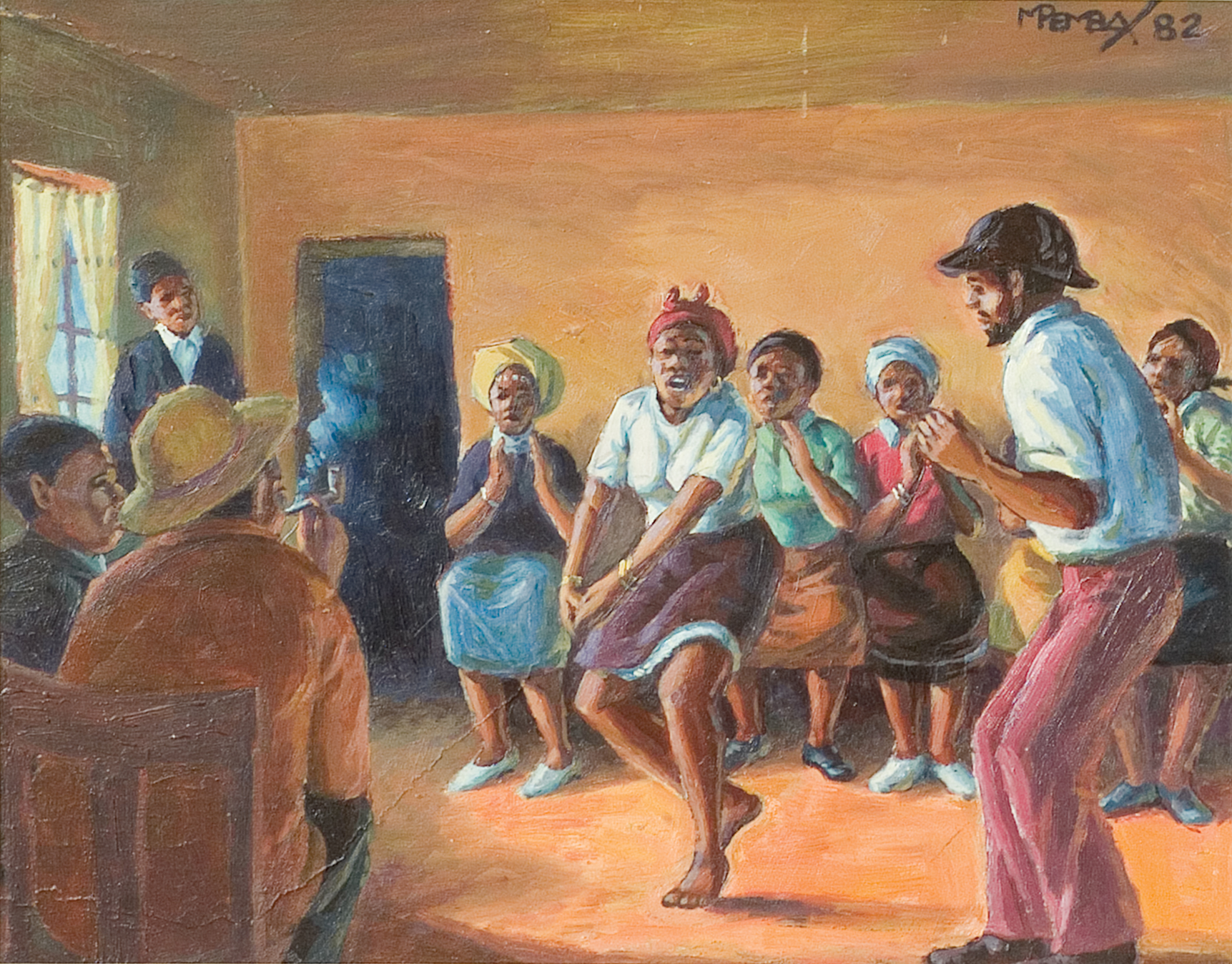
Title: Township dance
Medium: Oil on canvas
Signed and dated: 82
Unframed: 30cm x 38cm
Framed: 54.5cm x 63
For me, this painting titled, Township dance, is the best example of a Social Realist painting made by Pemba. It represents an ordinary gathering with joyful dancing in someone’s house, but it also represents so much more! The naturalistic style is remarkably like American social realist paintings from the 1930s.
To understand this painting reference must be made to township jazz in South Africa that originated in Marabastad in the 1930s. With the removal of the slum yards, these gathering places moved to Sophiatown and Alexandria. At the time people talked about this dancing culture as Marabi. Wilson ‘King Force’ Silgee (Music and culture forms resistance 2019:1), a famous jazz saxophonist described Marabi as: “…the environment…You get there, you pay your 10 cents. You get your share of whatever concoction there is – and you dance. It used to start from Friday night right through to Sunday evening.”
The Marabi was the start of the Shebeen: an informal bar with music for dancing at a house in the township. The Shebeen was also the gathering place to discuss politics, the resistance space in South Africa at the time. This space was illegal until 1994. Through Tsaba-tsaba, Kwela-kwela, Phata-phata and Mbaqanga, musicians protested Apartheid’s dehumanizing discrimination. After the destruction of Sophiatown many musicians left South Africa in the late 1950s and early 1960s. For example: Mirriam Makeba, Hugh Masekela, Letta Mbuli, Caiphus Semenya and Jonas Gwanga (Music and culture forms resistance 2019:1). Township dance parties were defying Apartheid in South Africa. Claiming culture and humanity.
